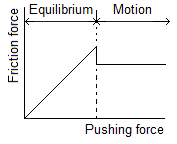
If increase the pushing force, the static-friction force also increases, continuing to oppose pushing force, until its magnitude reaches a certain maximum value. If pushing force is further increased, the friction force can not balance it anymore, and the body starts sliding. As soon as the body has started in motion, the magnitude of friction force drops from maximum to a lower value. This happens because less interpenetration occurs between the irregularities of the surfaces in contact when these surfaces move with respect to each other. From then on, the body keeps sliding with increasing velocity while the friction force, called the kinetic-friction force, remains approximately constant.