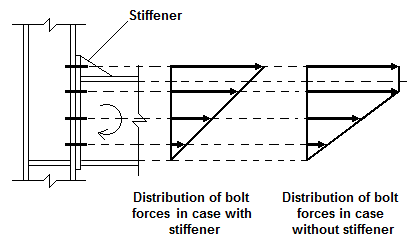
In the beam-column connection the applied moment is transmitted by compression in the lower part of the beam and by the bolts in tension in the upper part. The compression path is relatively much stiffer than the tension paths. Due to this difference in stiffness, the connection tends to rotate about the bottom flange. At the stage of loading when the end plate and column flange are elastic they may be considered as springs. In practice the spring stiffnesses for the bolt positions vary with bolt spacing but for design this variation are generally ignored and the spring stiffnesses are assumed to be the same at each bolt and the tension in each bolt is then proportional to its distance from the point of rotation. There is one generally accepted modification to the distribution of bolt forces, which is used for the extended end plate detail where there is no stiffener above the tension flange. In this case equal forces are assumed in the bolts above and immediately below the flange. The reason for this modification is that the end plate below the flange is stiffer than the cantilever portion of the end plate above the flange and tends to attract more load.